

Serendipity involves both choice and chance as fortune favors the prepared mind. Entrepreneurs shift and expand their Luck Surface Area in three ways leveraging luck to augment talent and seize opportunity.
Are successful entrepreneurs good because they are lucky or lucky because they are good?
Serendipity plays a role in every successful startup. Luck sometimes seems haphazard as when COVID killed many startups but propelled Zoom and Shopify to IPOs. Yet great entrepreneurs often make their own luck. Recent research confirms that luck involves both choice and chance. Believing we are lucky can become a self-fulfilling prophecy as mood effects outcomes. In Great by Choice, the authors describe a 10X Luck Multiplier effect in which some firms seize a higher return on luck than others even when luck is evenly distributed.
Luck and entrepreneurship are inextricably intertwined. Entrepreneurship is the art of recognizing and seizing opportunity. Startups seek inflection points – dramatic increases in growth – which may reflect the benefits of network effects and economies of scale, yet inflection points often involve capitalizing on serendipity. How might Microsoft have fared if IBM, the dominant computer manufacturer at that time, chose another firm to write its operating system?
Luck is rarely an isolated, dramatic lightning strike as with COVID. Luck lurks in the background available to those who can find and seize it. Great entrepreneurs consistently convert serendipity into opportunity. All inaugural members of Babson’s Academy of Distinguished Entrepreneurs attributed their success to both hard work and luck.
Successful entrepreneurs do not play with loaded dice. Chance is a stochastic process, and many events are beyond their control. In the Power Law: Energizing Returns on Chance, we explored the stochastic nature of chance and showed how innovators and investors can exploit arbitrage opportunities inherent in the venture process. An entrepreneurial mindset extends the capacity of aspiring founders to more frequently encounter, recognize and seize opportunity.
We start by developing a model that explains the role of luck in uncertain situations, which is common among startups and early-stage industries. We then discuss how an entrepreneurial mindset can influence luck. In the Serendipity Mindset, we discuss strategies entrepreneurs can use to augment startup success by cultivating serendipity and seizing opportunities presented by fortuitous circumstances.
Luck Surface Area & Uncertainty in Startups and Early-Stage Industries:
Fortune favors the prepared mind. Serendipity is both a source of disruptive startup ideas and a catalyst for startup growth.
Founders launch startups when intent meets opportunity. Founders of many recent disruptive unicorn IPOs attribute their startup idea to serendipitous insights from daily activities, personal interests or work. Starbucks emerged from a vacation in Italy; Airbnb from lack of hotel rooms during a popular conference; Uber from difficulty finding taxis late at night; Lyft from observing a communal ride system in Zimbabwe; Peloton from an avid biker seeking efficient workouts in New York City; Slack and Unity from residual code developed for failed gaming startups; DoorDash and Squarespace from collegiate interests; GitLab as a code repository from a self-taught software programmer; and PagerDuty from three Amazon developers who exploited a shift to microarchitectures.
Ambitious entrepreneurs operate in rapidly changing industries. Small early wins can have an outsized impact in crowded, nascent markets. Early wins often come through personal connections when new technologies are undifferentiated and unproven. A key strategic partnership or customer win decided on prior relationships energizes future performance by endowing startups with a halo effect that influences all future decisions.
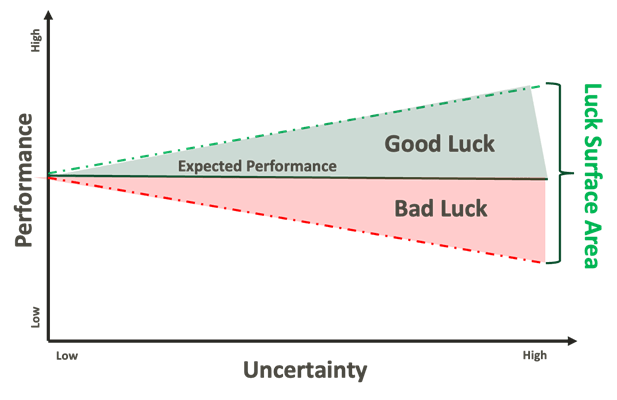
Luck Surface Area reflects the role of serendipity in outcomes. Luck Surface Area increases with uncertainty partially explaining variance in expected firm performance over time. Luck interjects itself with uncertainty as company merits alone may be insufficient to differentiate firms among competitors. Luck may skew positive or negative when chance impacts an entire industry, yet one firm’s good fortune may be another firm’s bad luck when decisions shift the competitive balance, especially in winner-take-most markets. Thus, figure 1 shows Luck Surface Area equally distributed between good and bad luck while increasing with uncertainty.
Figure 1: Luck Surface Area Increases with Uncertainty
The Entrepreneurial Mindset: Expanding and Adjusting Our Luck Surface Area
Luck is unwelcome in business parlance as any loss of control is disconcerting to entrepreneurs and investors. Luck is lost in the lexicon of leaders, who claim credit for success and dismiss disappointments to external circumstances or, worse, as acts of volition (explaining customer churn, for example, as “we fired bad customers”). Corporate cultures that embody this mindset risk managing serendipity out of the business through rigid planning, budgeting and oversight. We can and should do better.
Luck augments talent. The entrepreneurial mindset cultivates serendipity as an acquired skill embracing it as a source of smart luck rather than dismissing it as a loss of control. While force majeure situations are beyond our control, economists attribute ‘path dependent outcomes’ to the role of circumstances that influence industry and competitive dynamics. Luck is stochastic in the short term, but the test of leadership is how firms respond to and influence luck over time. Thus, luck often augments talent in the long term.
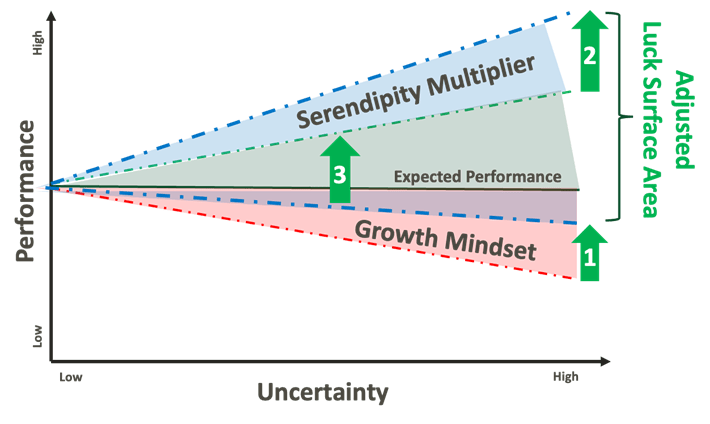
An entrepreneurial mindset shifts the Luck Surface Area upward in Figure 1 by managing risks and embracing serendipity. Entrepreneurs can adjust their Luck Surface Area by (1) mitigating the negative effects of bad luck; (2) seizing serendipitous opportunities to maximize their upside potential; and (3) expanding their Luck Surface Area by increasing exposure to serendipity. Figure 2 illustrates this three-fold strategy for influencing luck.
Figure 2: An Entrepreneurial Mindset Expands and Favorably Shifts the Luck Surface Area
- Growth Mindset: Embracing Adversity as a Lever for Growth
All successful startups endure crucible moments, unexpected challenges that could be existential. Innovators run a gauntlet of skepticism while defending attacks from entrenched incumbents. Machiavelli’s fifteenth century ode to innovators remains true today: “There is nothing more difficult to plan, more doubtful of success, nor more dangerous to manage than the creation of a new order of things … Whenever his enemies have the ability to attack the innovator they do so with the passion of partisans, while others defend him sluggishly, so that the innovator and his party alike are vulnerable.”
Entrepreneurship requires resilience, persistence and adaptability. In Grit, Angela Duckworth observed that high achievement derives more from passion and perseverance than intelligence. In Mindset, Carol Dweck showed how a growth mindset can overcome adversity by embracing challenges, focusing on processes rather than outcomes, learning from failure, and adapting as needed. Many successful firms founded new markets only after pivoting from failure in more established businesses. Slack began as an internal messaging tool for gamers but pivoted to a corporate software messaging platform when the gaming company failed. YouTube began as a dating app but pivoted to an online hub for videos when users began uploading random clips onto the site.
A growth mindset strives for constant improvement viewing challenges as opportunities for growth and failure as feedback that must not be ignored. By focusing on process over outcomes, a growth mindset draws inspiration from others’ success and applies best practices from many sources to one’s own path toward mastery.
Entrepreneurs must decide whether to persevere or pivot when facing failure. Startups have limited resources and narrow windows of opportunity so small setbacks can have outsized consequences. Startups must course correct quickly and arrest domino effects that can quickly turn into a death spiral.
During COVID, we observed tremendous resilience and creativity among several portfolio companies. They embraced the hard reality of COVID fortified by a “survive and thrive” mentality to persist through the crisis. Several firms used downtime to improve the product and adjust their go-to-market strategy. The downturn narrowed the competitive field enabling survivors to thrive after the crisis. Several whose positions seemed dire during COVID have rebounded well and are now preparing for public offerings.
2. Seizing Opportunity: The Serendipity Multiplier
In Great by Choice, Collins and Hanson found that great companies are not necessarily more lucky but they achieve a higher return on luck than their competitors. Great companies earn a higher multiple on serendipity by perceiving and seizing opportunity better than other firms.
Entrepreneurship is a latent trait that lies fallow when opportunities are overlooked. Opportunities are often available to many yet, as the ‘invisible gorilla’ test shows, it is easy to get distracted by routine tasks and miss opportunities that are hidden in plain sight. Alertness and initiative are central building blocks in John Wooden’s Pyramid of Success reinforcing the importance of perceiving and seizing opportunities.
Seizing opportunities requires both initiative and spare capacity. CK Prahalad defined poverty as the inability to access opportunity. Either through the lack of time or resources, most are impoverished in some way. Firms are often so focused on efficiency that teams have neither the time nor resources to seize serendipitous opportunities.
Innovative firms have two responsibilities: to exploit current assets and explore future opportunities. Peter Drucker observed that these are distinct disciplines that must be managed separately. Yet sales and product development have more exposure to customer feedback, so companies must ensure good communication between hunters and gatherers or allow organizational slack for employees to pursue serendipitous opportunities. Innovative companies like Google and 3M, for example, reserve up to 20% of staff time to pursue creative projects.
One of my mantras for decades was: “It is better to be too busy than not busy enough.” This may be true for managers but not for creators, who require buffer time for serendipity. Much as Drucker proposed a different department to focus on exploration, I have found it best to compartmentalize activities and reserve time at the start of the day with a fresh, uncluttered mind for creative work.
3. Fortune Favors the Prepared Mind: Expanding Your Luck Surface Area
An entrepreneurial mindset augments the Luck Surface Area by increasing their exposure to serendipity. Entrepreneurs expand their Luck Surface Area with a prepared mind and positive mindset.
Prepared Mind: An estimated 30-50% of inventions are accidental. The microwave oven, penicillin, x-rays, pacemakers, Teflon, dynamite and dry cleaning are among the many notable products that were invented serendipitously. Yet as the Post-It note story illustrates, serendipity often requires a prepared mind through years of preparation and persistence to bring a discovery to fruition. Weak adhesives were developed by Dr. Spencer Silver, a senior chemist in 3M’s research laboratory who had devoted three years developing strong industrial adhesives. Silver promoted his discovery for two years before Arthur Fry, a chemical engineer in 3M’s tape division, conceived of the Post-it note use case for this weak adhesive.
Positive Mindset: Wayne Gretzky, the all-time points leader in the National Hockey League, said you miss 100% of the shots you don’t take. Creative people may produce more great ideas simply by producing more ideas.
A positive mindset expands Luck Surface Area by enabling more initiative and risk taking. In The Luck Factor, Wiseman emphasizes that serendipity involves being in the right state of mind as much as being in the right place at the right time. In his study of thousands of lucky and unlucky people, Wiseman found that people who consider themselves lucky are not more intelligent or agreeable, but they are more positive, extrovert, open, curious, persistent and intuitive. In the Serendipity Mindset, Busch corroborated these traits through his research. A positive mindset enables one to cultivate serendipity by being more open to new experiences, better at recognizing and seizing opportunities, and better at finding the silver lining when bad luck occurs.
Great entrepreneurs are relentlessly positive and share the Serendipity Mindset traits noted above. Seeing a glass half full instead of half empty remains logical and just requires a positive shift in mindset. Great entrepreneurs create reality distortion fields that turning a glass three quarters empty into three quarters full. Successful startups often punch above their weight to win referenceable customers, attract strategic partners and recruit top talent. Entrepreneurs routinely over promise, which is why the Gartner Hype Cycle has persisted for 30 years. Yet great entrepreneurs then deliver on lofty expectations in part by expanding their Luck Surface Area to align reality with their worldview.
– – –
Is belief in luck a self-fulfilling prophecy? Can we make our own luck? Our rational minds presuppose that chance matters more than choice. My experience with entrepreneurs has convinced me otherwise. Research affirms our investment experience.
An Entrepreneurial Mindset can expand and shift the Luck Surface Area of startups. Serendipity augments talent through smart luck, not solely happenstance.
If you are likewise convinced, or at least intrigued, then read on for practical strategies to improve your Luck Surface Area.
For Further Reading:
The Serendipity Mindset: The Art and Science of Creating Good Luck, Christian Busch: Luck involves seeing overlooked links, combining observations in unexpected and strategic ways, and converting serendipity into opportunity. Busch advises entrepreneurs and startups to develop a serendipity mindset to increase innovation and success from chance events.
The Luck Factor: The Scientific Study of the Lucky Mind, Richard Wiseman: Based on a study of over 1000 self-described lucky and unlucky people, Wiseman finds that people can make their luck through a growth mindset, openness to new ideas, networking, persistence and adaptability. Many practical examples from his extensive research.
Great by Choice, Jim Collins and Morten Hansen: Discusses how some companies thrive in uncertainty outlining principles for building a great company in unpredictable, tumultuous, fast-moving times. Describes the 10X Luck Multiplier: companies that thrive in uncertainty exploit luck more effectively.
The Luck Factor: Transforming Chance into Opportunity, Stuart Thompson: Luck transcends mere chance; it blends opportunity with preparation, initiative and persistence. A growth mindset can sway the odds in their favor through openness, proactivity, resilience and gratitude.
The Luck Factor: Myth and the Reality, William Davis: Entrepreneurs inevitably deal with opportunity and adversity. Optimism and enthusiasm help seize opportunities and overcome adversity.
Related Concepts:
Startups operate in uncertain environments. The Map is Not the Territory and luck unfolds as entrepreneurs unsurface known unknowns and unknown unknowns. Crucible Moments often emerge when luck, good and bad, derail plans. Sequoia Capital uses premortems and pre-parades to assess what must go right and could go wrong to make or break a business before committing to the investment. The military uses OODA Loops (Observe Orient Decide Act) to respond quickly to events that unfold during the fog of war and After Action Reviews to learn from prior decisions. Wingmen can help with pattern recognition and cover blind spots enabling founders to respond more effectively to startup uncertainty.
In an uncertain world, startups adapt with customer feedback and market opportunities. Startups should avoid analysis paralysis in fast moving markets and maintain a Margin of Safety to withstand market downturns and pivot to market opportunity. Discerning signal from noise can be challenging in volatile markets. Serendipity may invoke inflection points, though entrepreneurs must avoid a domino effect when bad luck strikes. The Stockdale Paradox reminds entrepreneurs that they are best served by confronting brutal reality today while maintaining unwavering confidence in their ability to prevail in the end.
Discover more from Startup Cairns
Subscribe to get the latest posts sent to your email.
 Startup Cairns