


Happy new year!
The holiday season is a time of reflection. I hope that past year was a good one and wish you even more success in the year ahead!
Last year I wrote about Atomic Habits, which describes the three layers of behavioral change. Atomic Habits are the systems we use to change behaviors and drive desired outcomes. The half-life of new year’s resolutions is short – just thirteen weeks based on usage of online health apps – because they often skip to desired behaviors or outcomes without addressing the underlying systems that drive them. Last year, I discussed eight Atomic Habits that can help bring desired behaviors and outcomes to fruition.
New year’s resolutions are a forcing function that may serve two different purposes: to achieve specific milestones or alter behaviors. Goals to reach specific milestones require brief periods of intense effort followed by a return to a base level of activity after reaching the goal. These milestones typically build on established competency in that area of endeavor.
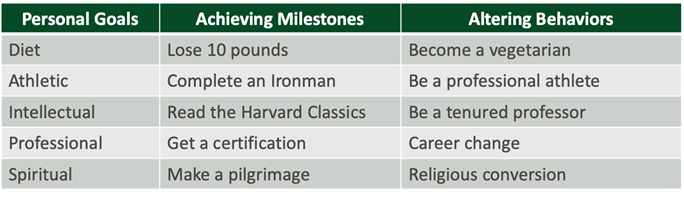
Forcing functions such as New Year’s resolutions are great for achieving specific milestones but they alone are insufficient to alter behaviors, which require more fundamental, longer-term changes. Sustained behavioral changes are harder as the chains of habit are too weak to be felt until they are too strong to be broken. As discussed in Fogg’s Tiny Habits and Duhigg’s The Power of Habit, creating or changing habits requires a repeatable trigger that prompts a desired behavior and a reward system to build early momentum. Table 1 illustrates the difference between personal milestones and behavioral resolutions.
Table 1: Goals for Achieving Specific Milestones and Altering Behavior
Forcing functions are the triggers that prompt changes to achieve milestones and alter behaviors. A New Year’s resolution is a catalyst that sets the flywheel in motion, but sustained effort is needed to turn the flywheel and build momentum. Sustained effort requires additional triggers to reinforce resolutions. With repeatable triggers and rewards for desired behaviors, habits are learnable and small, sustained changes build flywheel momentum that can drive large outcomes.
Forcing functions also apply to firms helping to align behavior, fulfill corporate objectives and build company culture. Companies have many standard mechanisms that serve as forcing functions, including quarterly earnings reports, annual budgets and shareholder meetings, board meetings, management meetings, personnel reviews, progress reports and decision memos. The risks of ignoring these standard mechanisms are evident when reviewing corporate autopsies as illustrated by the bankruptcy of cryptocurrency firm FTX, which raised $2.5 billion from investors without any governance oversight.
Yet I have also seen how well-designed, situation specific forcing functions can drive significant outcomes. KPIT’s Big Hairy Audacious Goal (BHAG) to reach $100M sales within four years focused and aligned company efforts. KPIT exceeded expectations, reached its goal and has gone on to become one of the leading tech firms in India. Lime’s BHAG to establish shared electric bike and scooter operations in over 100 cities across North America and Europe within one year required an integrated design, manufacturing and operating system that could scale and ultimately win the micromobility market. The disciplines established to achieve KPIT’s and Lime’s milestones changed behavior and became embedded in their cultures enabling them to scale far beyond their initial targets. Table 2 illustrates the difference between forcing functions to achieve company milestones and behavioral change, yet KPIT and Lime illustrate how near-term targets can set the flywheel in motion and build momentum for larger success.
Table 2: Goals for Achieving Corporate Milestones and Altering Behavior

Changing corporate culture is harder than personal change as it requires alignment of an entire firm with entrenched personal and organizational habits.
Recognizing this, John Doerr devoted his first book Measure What Matters to the topic of organizational change. One of the most successful venture investors of our time, Doerr may have spoken authoritatively on many topics vital to our age. His promontory perspective as early investor in Google, Amazon, Tesla, Twitter, Intuit, Sun Microsystems, Netscape and Compaq offers an inside look at how to scale leading tech firms. Instead, he devoted his prodigious energy and intellect to the relatively mundane topic of OKRs (Objectives and Key Results) explaining that they were fundamental to his early success at Intel and several of his investments, including Google.
OKRs are a foundational forcing function applicable to any company. OKRs involve frequent, often weekly or bi-weekly, employee reports on outcomes aligned with a few critical corporate goals. A well-designed system of OKRs establish a culture of accountability, focus effort and reinforce alignment on a few critical firm objectives, improve communication across the firm, and enable rapid change to align activity with company goals and market requirements.
Sunlight is the best disinfectant. As an investor, I have seen thousands of variations on company performance measures. Financial reports may slice and dice metrics in myriad ways, yet simpler is better to focus employees and align company efforts. One to three key metrics are best, five max. Among startups the three most common metrics relate to measures of growth, efficiency and customer satisfaction. Key metrics supplement OKRs and quantifiably reinforce broader company objectives with SMART goals that are specific, measurable, achievable, relevant and time-bound.
Two words of caution apply as you consider New Year’s resolutions personally or for your company.
First, forcing functions involve overhead. Personal activities must be fun and rewarding to become habitual. For company activities, the benefits must outweigh overhead costs. OKRs can be effective but they are costly to implement so must be carefully calibrated to work sustainably. Key metrics have lower overhead costs but may need to be translated by line managers to make them relevant to all employees.
Second, key metrics and OKRs involve both noise and signal, especially with low volume and more frequent observations. Discerning signal from noise requires judgment. Over indexing on good or bad news may yield a positive or negative bias. As Bill Parcels, a two-time Super Bowl champion NFL coach, used to tell his players after a loss, you are not as bad as you think you are. But the reverse may also be true as winning may indulge complacency.
Best wishes in 2026! May you achieve all your summits!
Discover more from Startup Cairns
Subscribe to get the latest posts sent to your email.
 Startup Cairns