
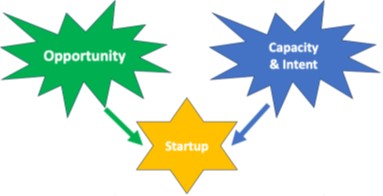
Entrepreneurship is a latent trait lying dormant in many and activated by intent to identify an opportunity and launch a startup. As fortune favors a prepared mind, this article presents ten ways aspiring entrepreneurs can prepare for an opportunity that can define their legacy.
Startups are launched when opportunity meets intent. Entrepreneurship is a latent trait. Entrepreneurial intent lies dormant until an idea impels a founder to take the leap and pursue the opportunity.
Do you have what it takes? Are you ready? By clicking to read this, you have exercised entrepreneurial intent. Now let’s discuss how to prepare for an opportunity that can define your legacy.
No Regret Decisions: Bezos and the Launch of Amazon
Jeff Bezos’s decision to launch Amazon and forego a Wall Street career is now startup lore. When Bezos disclosed his intent to leave, his boss gave him 48 hours to reconsider noting the opportunity was good but better for someone without a lucrative job. Many aspiring entrepreneurs confront this Golden Handcuff conundrum as the opportunity cost of launching a startup is high for talented people. Many are called but few are chosen.
Bezos ultimately confirmed his intent to launch Amazon using a regret minimization strategy. Imagining that he was reflecting on his life at age 80, Bezos realized that pursuing Amazon was a no regret decision. Not pursuing Amazon would have forever haunted him, and Bezos felt confident he could still pursue a career on Wall Street if his startup failed.
Errors of omission often loom larger than errors of commission for diligent people later in life. Errors of commission are piercing in the moment. But as a ski instructor once observed, if you are not falling, then you are not trying hard enough. Errors of omission, by contrast, are painless in the moment but ache more over time as one imagines what might have been. As a crusty Wall Street advisor observed, if ‘ifs’ and ‘buts’ were candies and nuts, it would be a hell of a Christmas.
Startups thrive on no regret decisions. They enable leaps of faith and steel founders for what lies ahead. Amazon took a year to raise its first funding round and its future seemed bleak in the wake of the dotcom crash. No regret decisions also encourage bigger thinking. Expanding Amazon from an online book seller to the everything store was audacious. Launching Amazon Web Services and expanding into traditional retail and logistics seemed tangential to the core business. A Wall Street career offered Bezos a fulfilling career and comfortable life. At Amazon, Bezos made a dent in the world and emerged as the third richest man on earth.
Entrepreneurial Intent: In Pursuit of Opportunity
Aspiring entrepreneurs face two foundational challenges: (1) identifying an opportunity worth pursuing and (2) overcoming inertia to pursue it.
Few entrepreneurs launch startups during or immediately after college. The average age of successful venture-backed founders is 32 years old with eight years prior work experience. Experience embeds entrepreneurs in the local ecosystem offering access to ideas, funding and talent to launch a startup. But experience also raises resistance to startup risk as promotions and pay mount. Corporate life is comfortable, and the myopic treadmill of daily meetings, quarterly earnings calls and annual budgets rewards adherence to industry best practice and corporate norms that discourages disruptive thinking.
Founder-market fit prescribes a Goldilocks scenario: investors want enough experience but not too much. Some experience may be needed to scale a startup, but too much experience raises resistance to new ideas and numbs nimbleness needed to navigate in rapidly changing, uncertain environments. Following are ten strategies to remain vigilant in search of startup opportunities while gaining requisite experience to maximize startup potential.
- Location, Location, Location: Go to the city where expertise abounds in your area of interest. Real estate agents know that property has five important attributes and the first three begin with L. Industries, funding and talent cluster. Despite expanded access to online information, complex and nuanced ideas travel within tight, local networks. Entrepreneurship rates vary up to six times within nations and scalable startups cluster among 24 cities, which account for 75% of global venture funding.
- Industry Experience: Experience matters but relevant experience differs for incremental and disruptive innovation. In my research on unicorn IPOs, incremental innovation benefits from industry experience with an industry leader, while disruptive innovation emerges from first principles thinking, user experience or working with other startups. In either case, working with respected firms and with experts in their field offer both perspective and pedigree to pursue high potential startups.
- Expertise: Excel at one important thing needed to scale your startup and win the market. Digital industries are winner-take-most markets that attract stiff competition. An organization is the height and breadth of the shadow cast by its leader. While many hands will be required to scale your startup, effective leaders establish the standard that others will follow.
- Explore: Google may no longer uphold its 20% free time policy but the principle still applies for aspiring entrepreneurs. While a 20% threshold is likely unsustainable, commit a few hours weekly to explore new ideas.
- Network: Financial capital, human capital and social capital are three essential currencies for entrepreneurship. Networking expands access to the prerequisites of startups including ideas, opportunity, talent and funding. Go to startup meetups and industry events regularly. Reach out to prospective customers during the exploration stage to identify unmet needs and gaps in the market.
- Mentors: Advisors offer perspective and reinforce accountability. You may be surprised as I was early in my career at the willingness of wise mentors to share insights gathered from decades of experience. Prioritize relationships with industry experts, successful entrepreneurs and investors who offer different perspectives. Develop a personal board of advisors who can help guide your startup process and establish regular, at least quarterly, check-ins with each mentor. Give back at least as much as you are receiving from them by sharing insights from your explorations.
- Read Voraciously: People reveal themselves through the company they keep and information they consume. Many leading entrepreneurs are voracious readers, including Bill Gates, Elon Musk, Steve Jobs, Jeff Bezos and Mark Zuckerberg as are top investors David Rubinstein, Warren Buffett and Charlie Munger. Munger said, “In my whole life, I have known no wise people (over a broad subject area) who didn’t read all the time—none, zero. … My children … think I’m a book with a couple of legs sticking out.”
- Ideas Journal: Many exceptional artists, inventors and writers kept voluminous notebooks to develop their creative ideas. Thomas Edison’s library contains over 5 million pages of notes. Leonardo da Vinci filled notebooks with sketches, anatomical studies, engineering concepts and reflections. Other artists and inventors who kept detailed notebooks include van Gogh, Picasso, Klee, O’Keefe, Warhol, Tesla, Darwin, Graham Bell, Curie, Kepler, Jobs and Feynman. Use your journal both to reflect ideas and hold yourself accountable in your exploration, networking and reading activities.
- Startup Team: Gather a trusted group of colleagues with complementary skills and perspectives to brainstorm startup ideas. These sessions help assess both ideas and compatibility with prospective cofounders. While there is no substitute for being in startup trenches together, exploring ideas together is a good ‘try before you buy’ approach to forming a startup team.
- Skunk Works: Test ideas with prospective customers that pass concept stage within your network of friends and advisors. Establish hypotheses to test with prospective customers. Develop a minimum viable product if practicable to validate interest and solicit feedback from early adopters on the product, business model and size of opportunity.
While startup team composition and skunk works projects vary with the nature of your startup idea, the list above applies broadly across many startup opportunities. Experimentation and customer feedback work well for incremental improvements. Customer (and investor) feedback is often not reliable for disruptive ideas, so some startup ideas ultimately require personal conviction and a leap of faith. In such cases, no regret decisions are a useful barometer for aspiring entrepreneurs.
Related Concepts
No Regret Decisions are significant decisions undertaken in Crucible Moments during personal or company inflection points. No Regret Decisions are Thinking Slow exercises as they typically involve One-Way Doors in which decisions are not readily reversible. Personal decisions of this nature require additional care as they often invoke conflicting biases such as loss aversion or overconfidence and a bias for action or a status quo bias. The decision to start a business is the seminal Founders Dilemma. Founder Fit should be a foremost consideration for any startup decision. This article offers several Atomic Habits that facilitates entrepreneurial intent as
Discover more from Startup Cairns
Subscribe to get the latest posts sent to your email.
 Startup Cairns