
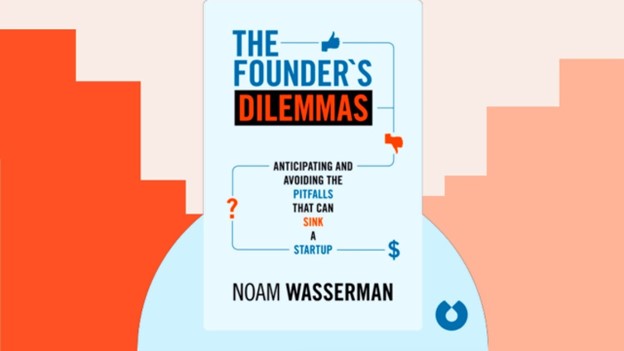
“If entrepreneurship is a battle, most casualties stem from friendly fire or self-inflicted wounds.”
The Founder’s Dilemmas is the bible that all aspiring entrepreneurs should read before starting a company. In one survey, venture capitalists attributed 65% of failures among their portfolio companies to problems within startup management teams.
Author Noam Wasserman aims to reduce casualties from friendly fire by helping cofounders anticipate and avoid pitfalls that can sink a startup. He draws his observations from a review of founding teams from over 3500 startups, including a database of 4232 founders from 1542 venture-backed technology startups.
This summarizes salient observations from Founder’s Dilemmas. The book is parsimonious and packed with insight, so go to the source for wisdom on selecting and designing a founding team.
Startups are a marathon comprised of a series of 100-yard dashes. Decisions in any single dash can throw startups off course or put them out of the race altogether.
Overoptimism is both a boom and bane for founders. Over 95% of founders believe at the outset that they have a 50%+ chance of success and 30% believe success is sure. Overoptimism enables entrepreneurs to aspire and occasionally achieve greatness. But higher optimism entrepreneurs have 25% lower growth than lower optimism entrepreneurs. Overoptimism also plays a role in underestimating and overlooking founder dilemmas.
Wasserman observes that founding teams must get three Rs right from the outset: Relationships, Roles and Rewards. Startups that align interests on the three Rs typically have resilient founding teams. Misalignment on any of these three are ticking bombs often hidden below the surface and tend to explode at the most inopportune moments. Conflict avoidance is the norm among cofounders, but postponed problems are harder and costlier to fix later.
- The two most common founder motivations are wealth and control. These objectives are often incompatible, so founders should prioritize one or the other at the outset. Startups driven by wealth have better outcomes. Those driven by control often end in founder fits.
- Relationships: Cofounders with prior shared work experience have the highest likelihood of success. Cofounding teams formed based on friendships are less stable than strangers.
- Diverse Skillsets: Roles and relationships are easier when a cofounding team has diverse skillsets. They are more successful in turbulent, complex contexts common for startups. Homogenous and heterogenous teams breed more conflict due to overlapping skills and less integration, respectively.
- Decision making: Balanced debate is best. Startups with dominant CEOs have 19% lower performance. But consensus-based teams move too slowly.
- Roles: Division of labor is a major source of tension unless skillsets are diverse and roles are clear. If founders are focused on control, then roles are the source of greatest tension.
- The desire of multiple founders to be CEO is a ticking bomb that is rarely visible externally.
- Overtitling of founders early in the startup is a challenge later. Overtitling increases the risk of having to demote or replace founders, which can be disruptive.
- Founding CEOs retain their CEO role 75% of the time after Series A, 62% after Series B, 48% after Series C and just 39% after Series D. Founder initiated changes are typically smooth, but change initiated by investors is disruptive.
- Rewards: The purpose of equity allocations and compensation structure is to align interests, clarify expectations and protect against negative surprises later. Yet when founders are focused on wealth, then rewards are the source of greatest tension.
- Equity may be split equally among founders or based on roles and expected contributions. But cofounders should not get locked in on equity allocations. It is best to stay flexible and adjust based on ongoing contributions and changing roles.
- Stock options may vest over time or with milestones achieved. Time is more common among established firms, yet vesting based on milestones may be useful among founders in the early stages of the business to align interests.
With the menagerie of potential challenges with relationships, roles and rewards, founders may wonder why they should entertain cofounders. Wasserman presents a balanced scorecard with pros and cons in founding a firm alone. Cofounders generally perform better than a single founder in complex, fast moving situations. Two to three cofounding teams generally perform best as complexity increases exponentially with more cofounders.
Discover more from Startup Cairns
Subscribe to get the latest posts sent to your email.
 Startup Cairns