
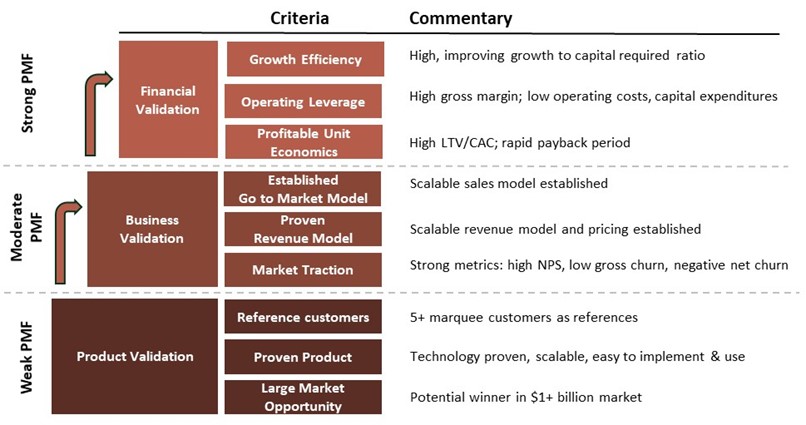
Product Market Fit progresses through three phases: product, business and financial validation. We discuss six practices that improve startup success by accelerating progress through these three stages.
“We don’t have product market fit.”
The Board room fell silent. How could a rapidly growing company with $50M revenues in a hot category not have product market fit? Yet having invested over $100M, we as a Board had just realized that lack of product market fit imperiled the business.
Product market fit (PMF) has evolved as a concept over time and PMF requirements increase as a business matures. Here is a schematic that we use to assess PMF prior to investment and among our portfolio companies:
We think of PMF in three stages: Product Validation, Business Validation and Financial Validation. These distinctions are meaningful as company success increases as startups progress from weak to moderate and strong Product Market Fit.
Across over 100 investments and over 50 exits at NGP Capital, we found that companies with Product Validation when we initially invested ultimately had a 25 percent success rate delivering attractive returns for investors and founders. Companies with Business Validation had a 50 percent success rate. Those with Financial Validation have had over a 90 percent success rate.
Optimizing Product Market Fit
Entrepreneurs and investors have a shared interest in achieving strong Product Market Fit quickly and capital efficiently. Running carefully designed experiments to sequentially validate the product, go-to-market strategy and unit economics can accelerate the path to PMF with moderate additional funding requirements. Following are five principles that we have observed among our company successes:
1. Avoid Premature Scaling. Companies win markets by being first to Product Market Fit, not first to market. Too often startups mistake early traction for PMF. Early adopters have varied reasons for trying a new product or service. Early adopters are often fickle and often do not reflect requirements of the majority of targeted customers. Net Promoter Scores are a good indicator of customer satisfaction and scores above 50 typically indicate Product Market Fit. Hiring after PMF speeds up companies. Hiring before PMF slows companies down, increases burn and capital requirements. Better to stay lean and agile before Product Validation and seek to scale only after Business Validation.
2. Go Deep Before Trying to Go Broad. Focus on and win a market segment. This is the fastest, most efficient way to test PMF and the business model at scale. Ganji first proved its mobile classifieds business in Beijing. When launching Shanghai, Ganji developed its expansion playbook and tested transferability of its model to a new city. Only after winning Shanghai did Ganji expand rapidly across China. Ganji sold for $3.6 billion in 2015, the largest tech acquisition in China at that time. Waze and Moovit refined their products in Israel until their transportation services went viral in a few cities and then used crowdsourcing to expand into nearly 250 cities in one year. Both companies ultimately were acquired for over $1 billion.
3. Iterate Quickly. In biology, species that reproduce rapidly (r-selection) survive and thrive best in unstable ecologies. Startups similarly thrive against larger competitors in fast-changing, uncertain markets by staying agile and iterating quickly. Market segmentation allows companies to run multiple carefully designed experiments in parallel to test key hypotheses and optimize business models. UCWeb, a mobile portal that Alibaba ultimately acquired for $4.9 billion, ran A/B tests daily on its mobile portal. Lime opened initially in a half dozen cities of varying size and demographics to test variations on its shared bike and scooter offerings before expanding to over 100 cities.
4. Focus on Revenues. Freemium business models are popular to accelerate early adoption, yet startups must ultimately be able to monetize traffic to build a sustainable, scalable business. Strong Product Market Fit requires a proven business model with sound unit economics and converting users to subscriptions is often harder than anticipated. Successful gaming companies such as Epic Games and Supercell typically have conversion rates below 10% and less than 2% of customers account for most revenues. While validating the product and go-to-market strategies, test different revenue models as well.
5. Measure Product Market Fit. NGP Capital benchmarks companies using key metrics for each of the nine stages of Product Market Fit. Peer group comparisons help entrepreneurs see where their companies must improve. Growth efficiency – a ratio of revenue growth to burn rate – improves substantially once a company has PMF. Good indicators of Product Market Fit are reduced sales cycles, payback periods of less than a year, and a 3x+ LTV/CAC (lifetime customer value to customer acquisition costs). High-performing companies tend to be early adopters of Net Promoter Scores. Phil Koen converted Intermedia, a cloud services business, to NPS early in his tenure and reported it in his CEO report at each Board meeting. With a renewed focus on customer service, NPS scores improved dramatically over two years and Intermedia ultimately sold for nearly $500 million.
6. Move Up the Product Market Fit Ladder. Successful companies generally first validate the product then perfect the business and go to market model and finally prove unit economics as the company scales. Yet only half the companies that achieve success at one level successfully graduate to the next level as these are distinct business phases requiring different skillsets and organizational requirements. The challenges of product validation and scaling a business are fundamentally different as Bain has observed in its study of successful startup companies and illustrated below.
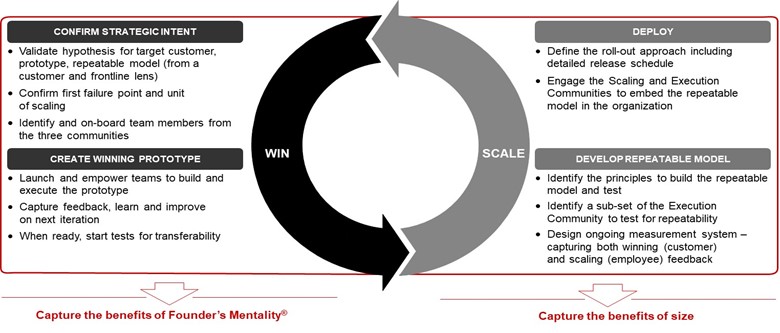
While graduation requirements vary by industry, talent is the common denominator to enhance success. Advisors and investors who have successfully built and scaled businesses can apply pattern recognition in helping your business navigate these transitions. Consider each phase as a distinct business effort and recruit relevant talent for the next phase of the business as you prepare to graduate. Recruiting proven talent in sales and business development can help accelerate Business Validation and finance and operations executives can help scale the business after Business Validation.
Achieving Product Market Fit through product, business and financial validation are essential steps in achieving ultimate startup success. Product Market Fit accelerates revenue momentum, shortens sales cycles, lowers customer acquisition costs and produces more lucrative outcomes. Ultimately, success is the accumulation of these small things done well.
Discover more from Startup Cairns
Subscribe to get the latest posts sent to your email.
 Startup Cairns